The Vietnamese textile and garment industry is facing a crucial turning point in the context of globalization and the Fourth Industrial Revolution. The application of digital technology and green trends not only opens up significant opportunities but also presents challenges requiring adaptation and innovation from businesses. This article will delve deeper into the opportunities, challenges, solutions, and preparations businesses need to make to maximize the industry’s future potential.
1. The context and current state of the textile and garment industry
2023 was considered an unprecedentedly difficult year for Vietnam’s textile and garment industry due to the effects of the global economic recession and inflation, as well as pressures on production and policy mechanisms. According to the General Statistics Office of Vietnam, in 2023, Vietnam ‘s total textile and garment export turnover was estimated at 40.3 billion USD , a decrease of more than 9% compared to 2022 (1) .
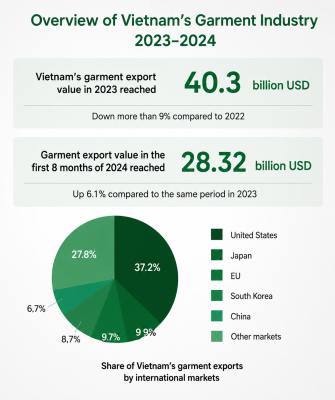
In 2024 , the textile and garment industry showed signs of improvement thanks to cyclical factors of increased demand for textiles and garments at the end of the year and recovery from key markets, with export figures for the first 8 months of 2024 estimated at US$28.32 billion , an increase of 6.1% compared to the same period in 2023 (2) . Vietnam’s main export markets still include the United States, Japan, the European Union (EU), South Korea and China.
Of these, the US is the largest market , accounting for 37.2% of the total export value . Second is the Japanese market with 9.9% . Next is the EU with 9.7% and South Korea with 8.7% . China is also an important market, with 6.7% of the total export value. The rest belongs to other markets, accounting for 27.8% (3) .
Vietnam is currently one of the world’s top 3 textile and garment exporting countries along with Bangladesh and China ( 4) . Vietnam’s role in the global supply chain is increasingly important thanks to its advantages in labor, stable political environment and the signing of many free trade agreements (FTAs) with major partners such as the Comprehensive and Progressive Trans-Pacific Partnership Agreement (CPTPP) and the EU-Vietnam Free Trade Agreement (EVFTA).
2. Opportunities for the Vietnamese textile and garment industry to transform and embrace new opportunities.
2.1. The crisis in Bangladesh opens up new opportunities.
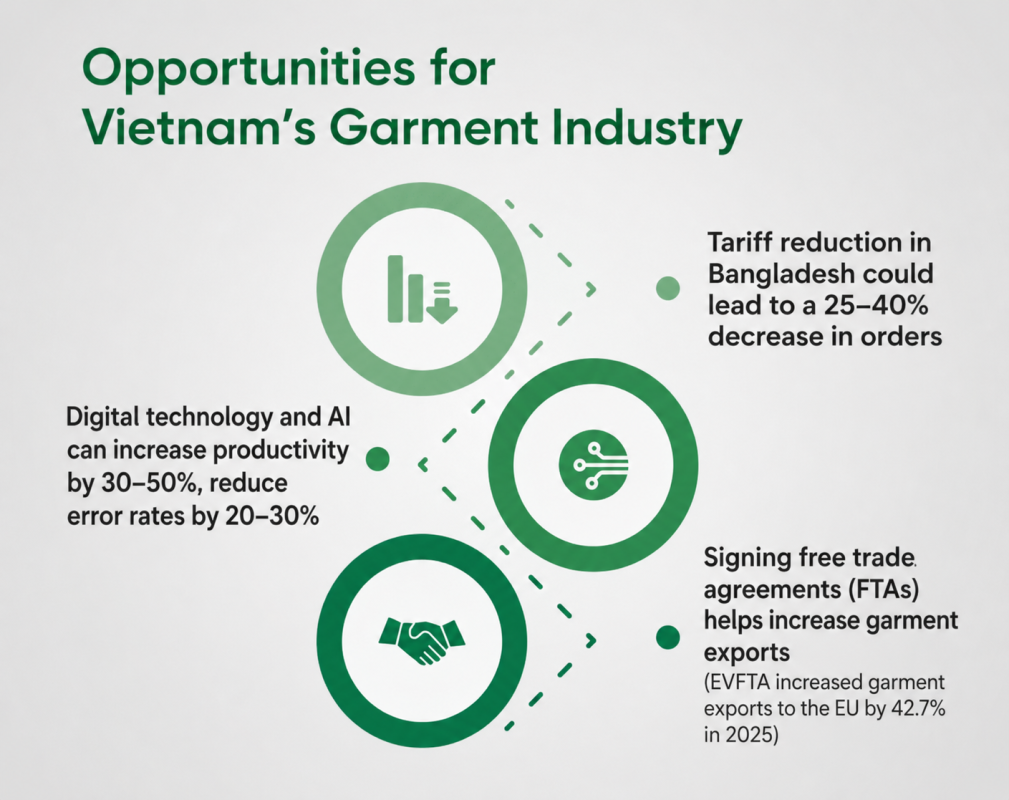
Bangladesh, once the world’s second-largest exporter of textiles , is facing serious challenges. Especially after the political conflict in August 2024 , Bangladesh had to close all member factories for three days. The resulting occupational safety issues led to a 25-40% drop in orders for many garment businesses in Bangladesh (5) . This has prompted many major fashion brands to review their supply chains to ensure compliance with international standards.
Vietnam has been effectively seizing this opportunity. Many international brands such as H&M, Zara, and Nike have shifted their orders to Vietnam, helping to increase export turnover and enhance the reputation of Vietnam’s textile and garment industry in the international market. This not only brings economic benefits but also helps Vietnam affirm its position as a reliable partner in the global supply chain.
2.2. Digital technology and AI are changing the game.
Digital technology and artificial intelligence (AI) are revolutionizing industries in general, and the textile and garment industry worldwide is no exception. The application of AI and Big Data helps optimize supply chains, manage inventory effectively, and forecast market demand more accurately.
Some studies show that the application of new technologies can help increase textile production efficiency by up to 30-50% thanks to process optimization with modern machinery, especially in fabric cutting stages. Product quality is also improved, reducing the product defect rate by 20-30% . This helps textile businesses optimize costs and improve competitiveness (6) .
In Vietnam, many textile and garment businesses have begun to approach and plan significant investments in applying new technologies to production. For example, May 10 Company invested in an automated sewing machine system and achieved impressive results in production efficiency in 2023. Vinatex is also a company that has successfully applied a smart production management system to improve efficiency and reduce costs.
2.3. Free Trade Agreements and Supply Chain Shifting Trends
The signing of free trade agreements (FTAs) such as CPTPP and EVFTA has opened up many opportunities for Vietnam’s textile and garment industry. Thanks to EVFTA, import tax on textiles and garments into the EU has been reduced to 0% for many items and is expected to indirectly help increase the proportion of Vietnamese exports to the EU to 42.7% in 2025. In which garment businesses which account for a large proportion of exports to this market also benefit (7) .
Furthermore, the US-China trade war has accelerated the shift in global supply chains. Multinational companies have turned to Vietnam as an alternative destination, with over 1,800 new FDI projects in 2023 , many related to the textile and garment industry. This has helped Vietnam not only attract more investment but also participate more deeply in the global supply chain, enhancing its international standing.
3. Challenges facing Vietnam’s textile and garment industry
Besides the opportunities already identified, the textile and garment industry also faces many challenges in the coming period, specifically:
3.1. High demands for a green and sustainable environment.
Developed markets such as the EU and the US are increasingly demanding higher environmental and social standards. The EU has adopted a “Circular Economy” strategy and requires products to be environmentally friendly, from raw materials to production processes and packaging. Compliance with these standards requires Vietnamese businesses to invest heavily in clean technology and sustainable production processes.
High investment costs and a shortage of highly skilled human resources also pose significant challenges. Many small and medium-sized enterprises (SMEs) struggle to access new technologies and meet the stringent requirements of international customers. Without rapid adaptation, businesses risk being excluded from global supply chains.
3.2. Shortage of high-quality labor
Despite the advantage of cheap labor, the quality and skills of the Vietnamese workforce remain limited. According to the Ministry of Labor, Invalids and Social Affairs, only about 25% of workers in the textile and garment industry had high-level technical skills in 2023. This shortage of high-quality labor affects the ability to adopt new technologies and improve product quality, reducing the competitiveness of businesses.
3.3. Competition from other countries
Another difficulty for Vietnam’s textile and garment industry is the issue of taxes and fees when exporting to the European market . The delay in applying green transformation leads to Vietnam being at a disadvantage compared to some countries, typically Bangladesh – a testament to the fact that Vietnam would find it very difficult to compete with Vietnam in terms of embracing sustainable development trends without the context of conflict in this country. And this is also a long-term problem that Vietnam must find a way to solve. Specifically: (1)
- Bangladesh has zero import tax on its entry into the European market , while the tax rate for Vietnamese businesses ranges from 5% to 20% .
- The Vietnamese currency is 20% more expensive than that of competing countries , including Bangladesh.
Furthermore, countries like Cambodia, Myanmar, and Ethiopia are emerging as new competitors in the textile and garment industry due to low labor costs and favorable investment policies . They are also investing heavily in technology and receiving support from international organizations, creating significant pressure on Vietnamese businesses to maintain and increase their market share.
4. What should Vietnamese textile and garment businesses do to respond to challenges and seize new opportunities?
To achieve sustainable development and maximize opportunities in the textile and garment industry, businesses need a comprehensive strategy focused on digital, sustainable solutions and international cooperation. The following are four main groups of solutions: